.webp)

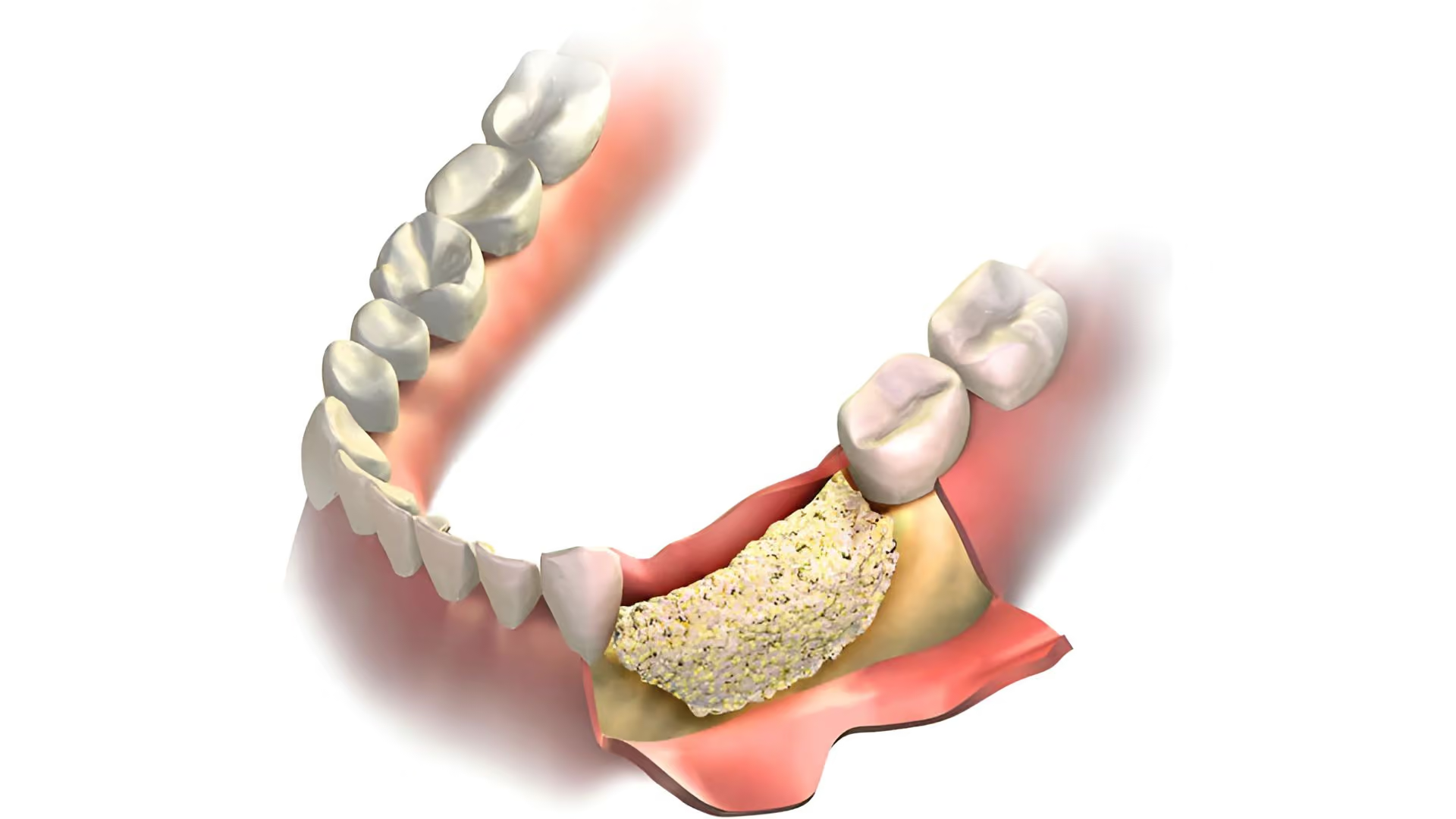
Bone grafting is one of the most technique-sensitive interventions in dentistry — and the outcome depends as much on material selection as on surgical execution. The four categories of bone graft material each have distinct biological mechanisms, clinical indications, and limitations. Choosing the right one for a specific defect is a clinical decision, not a default. This article explains what each category is, how it works biologically, and when it is the appropriate choice at Dazzle Dental Clinic.
The Three Biological Properties That Matter
Before comparing materials, it helps to understand the three properties that determine how effective a graft material is in a given situation:
Osteogenesis: The material itself contains living bone-forming cells (osteoblasts) that directly produce new bone at the graft site. Only autogenous bone has this property. It is the most powerful regenerative mechanism but requires the patient to have viable bone harvested from a donor site.
Osteoinduction: The material contains signalling proteins that stimulate the patient’s own undifferentiated cells (mesenchymal stem cells) to differentiate into bone-forming cells. Autogenous bone and some processed allografts have osteoinductive properties.
Osteoconduction: The material provides a physical scaffold through which the patient’s own bone-forming cells can migrate and populate, forming new bone on and through the graft structure. This is a passive role — the material enables bone growth but does not drive it. Xenografts and alloplastics are osteoconductive; they rely entirely on the patient’s biological response.
PRF is typically added to osteoconductive materials to introduce an osteogenic signal (growth factors PDGF, TGF-β, VEGF) into an otherwise passive scaffold. The combination of xenograft (scaffold) + PRF (biological activation) approximates many of the regenerative properties of autogenous grafting without a secondary surgical site.
Autogenous Bone Grafts
Autografts — bone harvested from the patient’s own body — remain the gold standard for large-volume bone defects where maximum regenerative potential is required. Common donor sites include the symphysis or ramus of the mandible (for small volumes), the iliac crest (for larger volumes requiring general anaesthesia), and local bone chips collected during drilling.
Advantages: All three biological properties (osteogenesis, osteoinduction, osteoconduction). No disease transmission risk. No rejection risk. Fastest and most complete regeneration of any graft type.
Limitations: Requires a secondary surgical site, which adds morbidity, healing time, and complexity. Iliac crest harvest requires general anaesthesia and hospitalisation. Volume available is limited by donor site anatomy. At Dazzle, autografts are used for complex maxillofacial cases where the regenerative demand exceeds what xenograft combinations can achieve. For most implant-related bone augmentation cases, xenograft + PRF provides comparable clinical outcomes without the secondary site burden.
Allogeneic Bone Grafts (Allografts)
Allografts are derived from human donors (cadaveric bone banks) and processed to remove cellular components while preserving the extracellular matrix. Processing includes irradiation, freeze-drying, or chemical treatment, each with different effects on the biological properties retained.
Advantages: No secondary surgical site. Available in large volumes. Some formulations retain osteoinductive properties (demineralised bone matrix, DBM, retains BMPs). Well-documented in periodontal regeneration literature.
Limitations: Disease transmission risk, though negligible with modern processing. Variable biological activity depending on processing method and donor. Less predictable osteoinductive potential than autograft. Some patients have ethical or religious objections to human-derived material. At Dazzle, allografts are used selectively, primarily for ridge augmentation and periodontal bone defect cases where the volume required or ethical considerations favour this category over xenograft.
Xenogeneic Bone Grafts (Xenografts)
Xenografts are derived from animal sources — most commonly bovine (Bio-Oss) or porcine (Geistlich). The organic components are removed through high-temperature processing, leaving the inorganic mineral matrix (hydroxyapatite scaffold) intact.
Advantages: Excellent structural stability. Very slow resorption rate (Bio-Oss persists for years), which provides long-term volumetric stability. Well-documented in sinus lift, ridge augmentation, and implant site development. Most commonly used graft material in implant dentistry globally. No secondary surgical site. Combined with PRF, provides a complete regenerative protocol for most implant-related augmentation needs.
Limitations: Purely osteoconductive — no osteogenic or osteoinductive properties without augmentation (hence the PRF combination). Very slow resorption means the graft particles persist as inclusions in the regenerated bone, which is not clinically significant but is radiographically visible. Some patients have religious objections to bovine-derived materials; porcine alternatives are available. At Dazzle, Bio-Oss xenograft with Bio-Gide collagen membrane is the standard protocol for most implant site augmentation, socket preservation, and sinus lift procedures.
Alloplastic Bone Grafts (Synthetic)
Alloplastics are synthetic bioactive materials — calcium phosphate ceramics (hydroxyapatite, beta-tricalcium phosphate), calcium sulphate, or bioactive glass — engineered to mimic the mineral phase of bone.
Advantages: No donor site, no disease risk, no ethical concerns. Some formulations (beta-TCP) are fully resorbable, which can be advantageous where the graft volume will be replaced by native bone. Bioactive glass formulations show some osteostimulatory properties beyond pure osteoconduction.
Limitations: Less clinical evidence volume than xenografts for most implant-related augmentation. Resorption rates vary significantly and are less predictable than xenografts for volume-critical cases. At Dazzle, alloplastics are used in specific contained defects where complete resorption is a clinical goal, or where patient preference excludes animal-derived materials.
FAQs
Q1: Which bone graft material is used most commonly at Dazzle?
For most implant site augmentation, socket preservation, and sinus lift cases, Bio-Oss xenograft combined with PRF and Bio-Gide collagen membrane is our standard protocol. This combination provides osteoconductive scaffold, biological activation from PRF growth factors, and membrane containment for GBR. Autografts and allografts are selected for specific indications where this combination is insufficient.
Q2: Can I request a specific graft material for religious or ethical reasons?
Yes. If bovine-derived xenograft is not acceptable, porcine alternatives or alloplastic synthetic grafts can be used. The clinical protocol is adapted accordingly. Please raise this at consultation so the material selection can be confirmed in the treatment plan.
Q3: How long does grafted bone take to be usable for implants?
For Bio-Oss xenograft in socket preservation: 3–4 months. For lateral window sinus lifts with xenograft: 6–8 months. For ridge augmentation with GBR: 6–9 months for major augmentations. With PRF in the graft, these timelines may be shortened by 4–6 weeks at some sites.
Q4: Is bone grafting always necessary before All-on-4?
No. All-on-4 with angled posterior implants is specifically designed to work in areas of moderate bone loss without grafting, by avoiding the sinus and anchoring in residual anterior bone. Bone grafting before All-on-4 is required only for specific anatomical situations or when the ridge deficiency would prevent even angled implant placement — which is less common than patients are sometimes led to believe. For complex bone loss cases, zygomatic implants may be the better alternative.