.webp)

Both overdentures and All-on-4 implants replace a full arch of teeth. Both use implants. Both are significant improvements over conventional dentures. But they are fundamentally different restorations — one removable, one fixed — and the choice between them is not simply a matter of budget. It involves your bone volume, bite requirements, daily lifestyle preferences, and long-term maintenance willingness.
This is an honest comparison. Neither option is universally superior. The right choice depends on your specific situation.
What an Overdenture Is
An implant-supported overdenture is a removable full-arch denture anchored to two to four implants via attachments — typically ball attachments, bar-retained clips, or magnetic connections. The overdenture snaps onto the implants, dramatically improving stability and retention compared to a conventional denture that simply rests on the gum. It still comes out for cleaning and at night.
Overdentures require fewer implants than All-on-4 (two to four, compared to four to six), which means lower implant cost and a more straightforward surgical procedure. They are also more accessible for patients with limited bone who may not be immediate All-on-4 candidates without grafting. The prosthesis is less complex to fabricate and easier to adjust or replace if damaged.
What All-on-4 Is
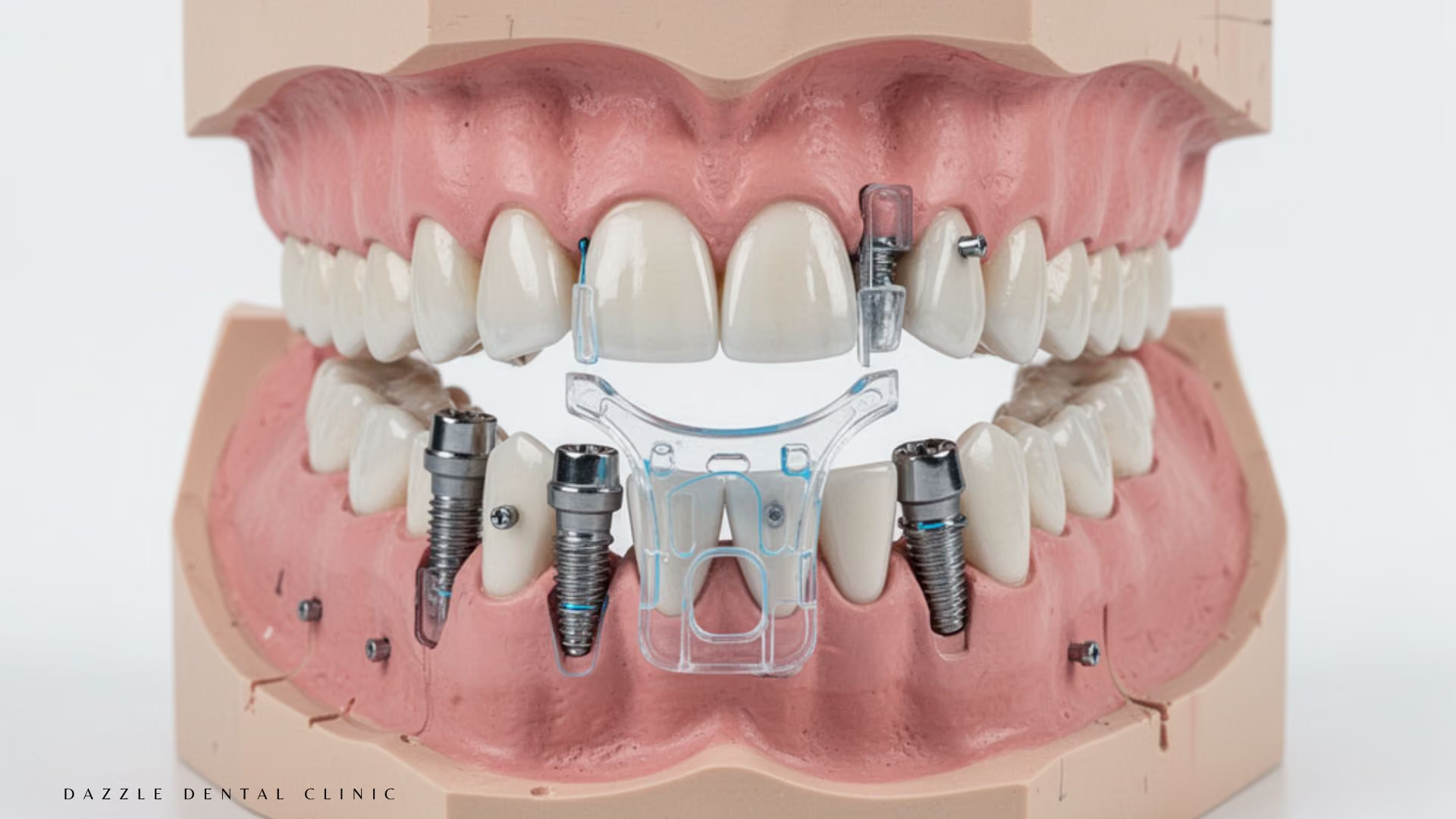
All-on-4 is a fixed, non-removable full-arch prosthesis permanently attached to four strategically angled implants. It does not come out. It functions like natural teeth and is maintained in the same way — brushing, water flossing, and professional cleaning. The prosthesis is removed only by the dentist for periodic professional maintenance or if adjustments are needed.
The defining feature of All-on-4 is the angled posterior implants, which maximise contact with denser anterior bone and typically eliminate the need for bone grafting even in patients with moderate resorption. Same-day loading — a provisional fixed prosthesis placed on surgery day — is routinely possible.
Where Each Option Performs Best
Overdentures are the better clinical choice when: bone volume is insufficient for four implants without extensive grafting and the patient wants to avoid that complexity; budget is a genuine constraint and the patient understands the maintenance trade-offs; the patient is comfortable with a removable prosthesis and the discipline of daily removal, cleaning, and reinsertion; or when the patient is elderly with systemic health factors that increase surgical risk and a simpler procedure is preferable.
All-on-4 is the better clinical choice when: the patient wants a fixed, permanent solution that does not need to be removed; bone volume supports four implants — which includes most cases of moderate resorption due to the angled implant design; long-term maintenance simplicity is a priority (a fixed bridge is easier to maintain than a removable prosthesis with attachment components that wear and require replacement); or the patient has been wearing an unstable conventional denture and wants the stability that only a fixed solution provides.
The Maintenance Comparison
This is where many patients make incorrect assumptions. Overdentures are often perceived as lower-maintenance because they're removable. In practice, the attachment components — the locators, clips, or bar fixtures — wear over time and require replacement every 1–2 years at periodic cost. The denture base may need relining as the underlying bone continues to change shape. The daily routine of removal and cleaning is more involved than brushing a fixed bridge in place.
All-on-4 requires consistent daily oral hygiene with a water flosser and interdental brushes under the bridge, and biannual professional cleaning appointments. The prosthesis itself has a longer functional lifespan — a zirconia full-arch bridge typically lasts 15–20 years without the attachment replacement costs associated with overdentures.
Cost: The Honest Long-Term Picture
Overdentures have a lower upfront cost. Over 10–15 years, the accumulated cost of attachment replacements, periodic relining, and potential prosthesis replacement narrows the gap. All-on-4 has a higher upfront cost. Over the same period, maintenance costs are primarily professional cleaning and, if bruxism is present, nightguard replacement. A full lifetime-cost comparison often makes All-on-4 more financially comparable to overdentures than the initial price difference suggests.
See our detailed All-on-4 cost guide for a complete breakdown of what's included in Dazzle's pricing.
Making the Decision
Both procedures are performed at Dazzle Dental Clinic as part of our full-mouth rehabilitation services. We have no financial interest in steering you toward the more expensive option. Our recommendation at consultation is based on your bone volume (assessed by CBCT), your medical history, your lifestyle preferences, and your financial parameters. We lay out both options honestly and let you decide with complete information.
For patients from the UK, GCC, Australia, and the USA, both procedures represent significant savings versus equivalent care in their home markets. Remote consultation is available; send us your existing CBCT for a preliminary assessment before you travel.
FAQs
Q1: Can an overdenture be converted to All-on-4 later?
In many cases, yes. Implants placed for an overdenture can sometimes be used as part of an All-on-4 system if they are in appropriate positions and have adequate osseointegration. Additional implants may be needed. This is a realistic upgrade path for some patients whose circumstances or preferences change over time.
Q2: Is an overdenture as stable as All-on-4?
No — it is considerably more stable than a conventional denture, but the prosthesis is still removable and can move slightly during function compared to a fully fixed bridge. For patients who find current denture instability distressing, an overdenture is a significant improvement. For patients who want the stability of fixed teeth, All-on-4 is the appropriate solution.
Q3: Which is better for severe bone loss?
Both can be placed in patients with bone loss. Overdentures require fewer implants and can be placed with less bone. All-on-4 handles moderate bone loss without grafting due to its angled implant design. For severe maxillary bone loss, zygomatic implants offer a fixed solution where neither conventional protocol may apply without augmentation — see our dedicated zygomatic implants treatment page.
Q4: Do overdentures look natural?
A well-made implant-supported overdenture looks considerably better than a conventional denture. However, the prosthesis base (the acrylic gum-coloured portion) is typically thicker than an All-on-4 bridge, which can affect the aesthetic profile and feel slightly bulkier in the mouth. For patients whose primary concern is stability rather than the absolute closest approximation to natural teeth, this is generally acceptable.